Sunday, February 19, 2023

Pope Francis Message for Lent 2023

 Pope Francis Message for Lent 2023 https://www.indcatholicnews.com/news/46575

The following text of the Holy Father Francis's Message for Lent 2023, was released at a press conference in the Vatican yesterday.

Lenten Penance and the Synodal Journey

Dear brothers and sisters!

The Gospels of Matthew, Mark and Luke all recount the episode of the Transfiguration of Jesus. There we see the Lord's response to the failure of his disciples to understand him. Shortly before, there had been a real clash between the Master and Simon Peter, who, after professing his faith in Jesus as the Christ, the Son of God, rejected his prediction of the passion and the cross. Jesus had firmly rebuked him: "Get behind me, Satan! You are a scandal to me, because you do not think according to God, but according to men!" (Mt 16:23). Following this, "six days later, Jesus took with him Peter, James and John his brother and led them away to a high mountain" (Mt 17:1).

The Gospel of the Transfiguration is proclaimed every year on the Second Sunday of Lent. During this liturgical season, the Lord takes us with him to a place apart. While our ordinary commitments compel us to remain in our usual places and our often repetitive and sometimes boring routines, during Lent we are invited to ascend "a high mountain" in the company of Jesus and to live a particular experience of spiritual discipline - ascesis - as God's holy people.

Lenten penance is a commitment, sustained by grace, to overcoming our lack of faith and our resistance to following Jesus on the way of the cross. This is precisely what Peter and the other disciples needed to do. To deepen our knowledge of the Master, to fully understand and embrace the mystery of his salvation, accomplished in total self-giving inspired by love, we must allow ourselves to be taken aside by him and to detach ourselves from mediocrity and vanity. We need to set out on the journey, an uphill path that, like a mountain trek, requires effort, sacrifice and concentration. These requisites are also important for the synodal journey to which, as a Church, we are committed to making. We can benefit greatly from reflecting on the relationship between Lenten penance and the synodal experience.

In his "retreat" on Mount Tabor, Jesus takes with him three disciples, chosen to be witnesses of a unique event. He wants that experience of grace to be shared, not solitary, just as our whole life of faith is an experience that is shared. For it is in togetherness that we follow Jesus. Together too, as a pilgrim Church in time, we experience the liturgical year and Lent within it, walking alongside those whom the Lord has placed among us as fellow travellers. Like the ascent of Jesus and the disciples to Mount Tabor, we can say that our Lenten journey is "synodal", since we make it together along the same path, as disciples of the one Master. For we know that Jesus is himself the Way, and therefore, both in the liturgical journey and in the journey of the Synod, the Church does nothing other than enter ever more deeply and fully into the mystery of Christ the Saviour.

And so we come to its culmination. The Gospel relates that Jesus "was transfigured before them; his face shone like the sun and his clothes became white as light" (Mt 17:2). This is the "summit", the goal of the journey. At the end of their ascent, as they stand on the mountain heights with Jesus, the three disciples are given the grace of seeing him in his glory, resplendent in supernatural light. That light did not come from without, but radiated from the Lord himself. The divine beauty of this vision was incomparably greater than all the efforts the disciples had made in the ascent of Tabor. During any strenuous mountain trek, we must keep our eyes firmly fixed on the path; yet the panorama that opens up at the end amazes us and rewards us by its grandeur. So too, the synodal process may often seem arduous, and at times we may become discouraged. Yet what awaits us at the end is undoubtedly something wondrous and amazing, which will help us to understand better God's will and our mission in the service of his kingdom.

The disciples' experience on Mount Tabor was further enriched when, alongside the transfigured Jesus, Moses and Elijah appeared, signifying respectively the Law and the Prophets (cf. Mt 17:3). The newness of Christ is at the same time the fulfilment of the ancient covenant and promises; it is inseparable from God's history with his people and discloses its deeper meaning. In a similar way, the synodal journey is rooted in the Church's tradition and at the same time open to newness. Tradition is a source of inspiration for seeking new paths and for avoiding the opposed temptations of immobility and improvised experimentation.

The Lenten journey of penance and the journey of the Synod alike have as their goal a transfiguration, both personal and ecclesial. A transformation that, in both cases, has its model in the Transfiguration of Jesus and is achieved by the grace of his paschal mystery. So that this transfiguration may become a reality in us this year, I would like to propose two "paths" to follow in order to ascend the mountain together with Jesus and, with him, to attain the goal.

The first path has to do with the command that God the Father addresses to the disciples on Mount Tabor as they contemplate Jesus transfigured. The voice from the cloud says: "Listen to him" (Mt 17:5). The first proposal, then, is very clear: we need to listen to Jesus. Lent is a time of grace to the extent that we listen to him as he speaks to us. And how does he speak to us? First, in the word of God, which the Church offers us in the liturgy. May that word not fall on deaf ears; if we cannot always attend Mass, let us study its daily biblical readings, even with the help of the internet. In addition to the Scriptures, the Lord speaks to us through our brothers and sisters, especially in the faces and the stories of those who are in need. Let me say something else, which is quite important for the synodal process: listening to Christ often takes place in listening to our brothers and sisters in the Church. Such mutual listening in some phases is the primary goal, but it remains always indispensable in the method and style of a synodal Church.

On hearing the Father's voice, the disciples "fell prostrate and were very much afraid. But Jesus came and touched them, saying, 'Rise, and do not be afraid.' And when the disciples raised their eyes, they saw no one else but Jesus alone" (Mt 17:6-8). Here is the second proposal for this Lent: do not take refuge in a religiosity made up of extraordinary events and dramatic experiences, out of fear of facing reality and its daily struggles, its hardships and contradictions. The light that Jesus shows the disciples is an anticipation of Easter glory, and that must be the goal of our own journey, as we follow "him alone". Lent leads to Easter: the "retreat" is not an end in itself, but a means of preparing us to experience the Lord's passion and cross with faith, hope and love, and thus to arrive at the resurrection. Also on the synodal journey, when God gives us the grace of certain powerful experiences of communion, we should not imagine that we have arrived - for there too, the Lord repeats to us: "Rise, and do not be afraid". Let us go down, then, to the plain, and may the grace we have experienced strengthen us to be "artisans of synodality" in the ordinary life of our communities.

Dear brothers and sisters, may the Holy Spirit inspire and sustain us this Lent in our ascent with Jesus, so that we may experience his divine splendour and thus, confirmed in faith, persevere in our journey together with him, glory of his people and light of the nations.

Rome, Saint John Lateran, 25 January, Feast of the Conversion of Saint Paul

FRANCIS

Friday, February 17, 2023

Pope Francis Explains Why Proclaim, What to Proclaim and How to Proclaim - ZENIT - English

Pope Francis Explains Why Proclaim, What to Proclaim and How to Proclaim - ZENIT - English: The Holy Father’s General Audience on Wednesday, February 15, on “The Passion for Evangelization: The First Apostolate [Is] the Believer’s Apostolic Zeal.”

Pope Francis Explains Why Proclaim, What to Proclaim and How to Proclaim

The Holy Father’s General Audience on Wednesday, February 15, on “The Passion for Evangelization: The First Apostolate [Is] the Believer’s Apostolic Zeal.”

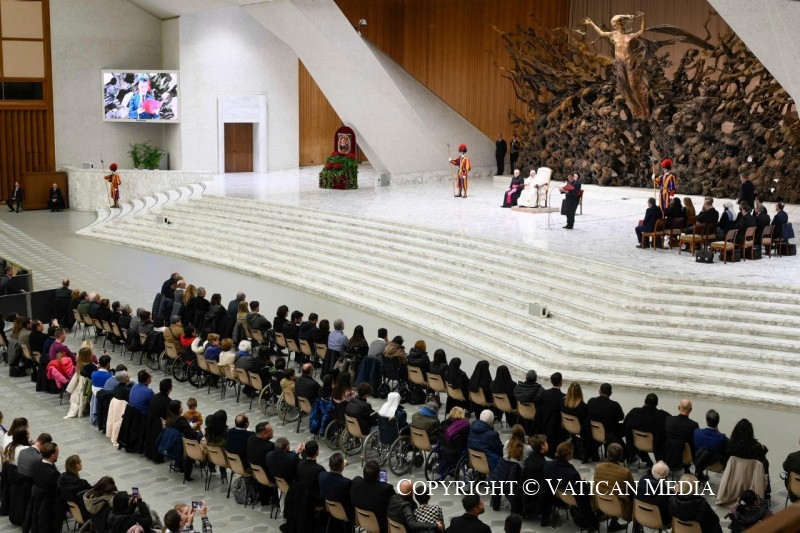
(ZENIT News / Vatican City, 15.02.2023).- Pope Francis held the Wednesday General Audience on February 15 in Paul VI Hall, which was virtually full. In his fourth catechesis on apostolic zeal, he addressed specifically three answers to the questions why proclaim, what to proclaim and how to proclaim.

Here is the text of the catechesis translated from the Italian original by the Holy See.

* * *

We continue our catechesis; the theme we have chosen is “The passion of evangelizing, apostolic zeal.” Because evangelizing is not saying, ‘Look, blah, blah, blah’ and nothing more. There is a passion that involves everything: the mind, the heart, the hands, going out . . .  everything, the whole person is involved with this proclamation of the Gospel, and for this reason we talk about the passion for evangelizing. After having seen in Jesus the Model and the Master of proclamation, we turn today to the first disciples, to what the disciples did. The Gospel says that Jesus “appointed twelve, to be with Him, and to be sent out to preach” (Mark 3:14), two things: to be with Him and to send them to preach. There is one aspect that seems contradictory: He called them to be with Him and to go and preach. One would say: either one or the other, either stay or go. But no: for Jesus there is no going without staying and there is no staying without going. It is not easy to understand this, but that’s the way it is. Let us try to understand a little bit what is the sense in which Jesus says these things.

First of all, there is no going without staying: before sending the disciples on mission, Christ — the Gospel says — “calls them to Himself” (cf. Matthew 10:1). The proclamation is born from the encounter with the Lord; every Christian activity, especially the mission, begins from there. Not from what is learnt in an academy. No, no! It begins from the encounter with the Lord. Witnessing Him, in fact, means radiating Him; but, if we do not receive His light, we will be extinguished; if we do not spend time with Him, we will bear ourselves instead of Him — I am bringing myself and not Him — and it will all be in vain. So only the person who remains with Him can bring the Gospel of Jesus. Someone who does not remain with Him cannot bear the Gospel. He will bring ideas, but not the Gospel. Equally, however, there is no staying without going. In fact, following Christ is not an inward looking fact: without proclamation, without service, without mission, the relationship with Jesus does not grow. We note that in the Gospel the Lord sends the disciples before having completed their preparation: shortly after having called them, He is already sending them! This means that the mission experience is part of Christian formation. Let us then recall these two constitutive moments for every disciple: staying with Jesus and going forth, sent by Jesus.

Having called the disciples to Himself and before sending them, Christ addresses a discourse to them, known as the ‘missionary discourse’ — this is what it is called in the Gospel. It is found in chapter 10 of Matthew’s Gospel and is like the ‘constitution’ of the proclamation. From that discourse, which I recommend you read today — it is only one page in the Gospel — I draw out three aspects: why proclaim, what to proclaim and how to proclaim.

Why proclaim: The motivation lies in a few words of Jesus, which it is good for us to remember: “Freely you have received, freely give” (v. 8). They are just a few words. But why proclaim? Because I have received freely, and I should give freely. The proclamation does not begin from us, but from the beauty of what we have received for free, without merit: meeting Jesus, knowing Him, discovering that we are loved and saved. It is such a great gift that we cannot keep it to ourselves, we feel the need to spread it; but in the same style, right? That is, in gratuitousness. In other words: we have a gift, so we are called to make a gift of ourselves; we have received a gift and our vocation is to make a gift of ourselves to others; there is in us the joy of being children of God, it must be shared with our brothers and sisters who do not yet know it! This is the reason for the proclamation. Going forth and bringing the joy of what we have received.

Second: What, then, to proclaim? Jesus says: “Preach as you go, saying, ‘The Kingdom of Heaven is at hand.’” (v. 7). This is what must be said, first and foremost: God is near. So, never forget this: God has always been close to the people. He said it to the people Himself: He said, “Look, what God is as close to the nations as I am to you?” This closeness is one of the most important things about God. There are three important things: closeness, mercy, and tenderness. Don’t forget that. Who is God? The One Who is Close, the One Who is Tender, the One Who is Merciful. This is the reality of God. We, in preaching, often urge people to do something, and that is fine; but let’s not forget that the main message is that He is near: closeness, mercy, and tenderness. Accepting God’s love is more difficult because we always want to be in the centre, we want to be protagonists, we are more inclined to do than to let ourselves be moulded, to speak than to listen. But, if what we do comes first, we will still be the protagonists. Instead, the proclamation must give primacy to God: to give the primacy to God, the first place to God, and to give to others the opportunity to welcome Him, to realise that He is near. And me in the background.

The third point: how to proclaim. This is the aspect Jesus dwells on most: how to proclaim, what is the method, what should be the language for proclaiming; it’s significant: He tells us that the manner, the style is essential in witnessing. Witnessing does not just involve the mind and saying something, the concepts. No. It involves everything, mind, heart, hands, everything, the three languages of the person: the language of thought, the language of affection, and the language of work. The three languages

One cannot evangelise only with the mind or only with the heart or only with the hands. Everything is involved. And, in style, the important thing is testimony, as Jesus wants us to do. He says this: “I send you out as sheep among wolves” (v. 16). He does not ask us to be able to face the wolves, that is, to be able to argue, to offer counter arguments, and to defend ourselves. No, no. We might think like this: let us become relevant, numerous, prestigious, and the world will listen to us and respect us and we will defeat the wolves. No, it’s not like that. No, I send you out as sheep, as lambs. This is important. If you don’t want to be sheep, the Lord will not defend you from the wolves. Deal with it as best you can. But if you are sheep, rest assured that the Lord will defend you from the wolves. Be humble. He asks us to be like this, to be meek and with the will to be innocent, to be disposed to sacrifice; this is what the lamb represents: meekness, innocence, dedication, tenderness. And He, the Shepherd, will recognise His lambs and protect them from the wolves. On the other hand, lambs disguised as wolves are unmasked and torn to pieces. A Church Father wrote: ‘As long as we are lambs, we will conquer, and even if we are surrounded by many wolves, we will overcome them. But if we become wolves — ‘Ah, how clever, look, I feel good about myself’– we will be defeated, because we will be deprived of the Shepherd’s help. He does not shepherd wolves, but lambs’ (St John Chrysostom, Homily 33 on the Gospel of Matthew). If I want to be the Lord’s, I have to allow Him to be my Shepherd; and He is not the shepherd of wolves, He is the shepherd of lambs, meek, humble, kind as the Lord is.

Still on the subject of how to proclaim, it is striking that Jesus, instead of prescribing what to bring on a mission, says what not to bring. At times, one sees some apostles, some person who relocates, some Christian that says he is an apostle and has given his life to the Lord, and he is carrying a lot of luggage. But this is not of the Lord. The Lord makes you lighten your load. “Take no gold, nor silver, nor copper in your belts, no bag for your journey, nor two tunics, nor sandals, nor a staff” (vv. 9-10). Don’t take anything. He says not to lean on material certainties, but to go into the world without worldliness. That is to say, I am going into the world, not with the style of the world, not with the world’s values, not with worldliness — for the Church, falling into worldliness is the worst thing that can happen. I go forth with simplicity. This is how one should proclaim: by showing Jesus rather than talking about Jesus. And how do we show Jesus? With our witness. And finally, by going together, in community: the Lord sends all the disciples, but no one goes alone. The apostolic Church is completely missionary and in the mission it finds its unity. So: going forth, meek and good as lambs, without worldliness, and going together. Here is the key to the proclamation, this is the key to success in evangelization. Let us accept these invitations from Jesus: may His words be our point of reference.

Saturday, January 14, 2023

The Call to the Apostolate: The Pope’s First Catechesis on Apostolic Zeal - ZENIT - English

The Call to the Apostolate: The Pope’s First Catechesis on Apostolic Zeal - ZENIT - English: The Holy Father’s General Audience on Wednesday, January 11, on “The Passion for Evangelization: The Believer’s Apostolic Zeal. The Call to the Apostolate (Matthew  9:9-13)”

(ZENIT News / Vatican City, 11.01.2023).- On Wednesday, January 11, the Pope began a new series of catecheses focused on the passion for evangelization. The catechesis was held in Paul VI Hall.

Here is the text in English with phrases and headers in bold added by ZENIT.

* * *

Today we begin a new cycle of catechesis, dedicated to an urgent and decisive theme for Christian life: the passion for evangelisation, that is, apostolic zeal. It is a vital dimension for the Church: the community of Jesus’ disciples is in fact born apostolic, born missionary, not proselytizing. And from the start we have to distinguish: being missionary, being apostolic, evangelizing, is not the same as proselytizing, they have nothing to do with one another. It concerns a vital dimension for the Church. The community of the disciples of Jesus is born apostolic and missionary. The Holy Spirit moulds it outwardly — the Church moves out, that goes out — so that it is not closed in on itself, but turned outward, a contagious witness of Jesus — the faith is also contagious — reaching out to radiate His light to the ends of the earth. It can happen, however, that the apostolic ardour, the desire to reach others with the good news of the Gospel, diminishes, becomes tepid. Sometimes it seems to be eclipsed; there are “closed-off” Christians, they don’t think of others. But when Christian life loses sight of the horizon of evangelization, horizon of proclamation, it grows sick: it closes in on itself, becomes self-referential, it becomes atrophied. Without apostolic zeal, faith withers. Mission, on the other hand, is the oxygen of Christian life: it invigorates and purifies it. Let us embark, then, on a process of rediscovering the evangelising passion, starting with the Scriptures and the Church’s teaching, to draw apostolic zeal from its sources. Then we will approach some living sources, some witnesses who have rekindled within the Church the passion for the Gospel, so that they may help us to rekindle the fire that the Holy Spirit wants to keep burning within us.

And today I would like to begin with a somewhat emblematic Gospel episode; we [just] heard it, the call of the Apostle Matthew. And he himself tells the story in his Gospel, which we have heard (cf. 9:9-13).

[Jesus’ Gaze Fixes on People’s Nouns, Not Their Adjectives]

It all begins with Jesus, who, the text says, “sees a man.” Few people saw Matthew as he was: they knew him as the one who was “sitting at the tax booth” (v. 9). He was, in fact, a tax collector: that is, someone who collected taxes on behalf of the Roman empire that occupied Palestine. In other words, he was a collaborator, a traitor to the people. We can imagine the contempt the people felt for him: he was a “publican,” as they were called. But in the eyes of Jesus, Matthew is a man, with both his miseries and his greatness. Be aware of this: Jesus does not stop at the adjective — Jesus always seeks out the noun. “This person is a sinner, he’s that kind of person…” these are adjectives: Jesus goes to the person, to the heart, “This is a person, this is a man, this is a woman.” Jesus goes to the subject, the noun, never the adjective, He leaves aside the adjectives. And while there is distance between Matthew and his people — because they see the adjective, “publican” — Jesus draws near to Him, because every man is loved by God. “Even this wretch?” Yes, even this wretch. Indeed, the Gospel says He came for this very wretch: “I have come for sinners, not for the righteous.” This gaze of Jesus is really beautiful. It sees the other, whoever he may be, as the recipient of love, is the beginning of the evangelising passion. Everything starts from this gaze, which we learn from Jesus.

[How Do We Look Upon Others?]

We can ask ourselves: how do we look upon others? How often do we see their faults and not their needs; how often do we label people according to what they do or what they think! Even as Christians we say to ourselves: is he one of us or not? This is not the gaze of Jesus: He always looks at each person with mercy and indeed with predilection. And Christians are called to do as Christ did, looking like Him especially at the so-called “distant ones.” Indeed, Matthew’s account of the call ends with Jesus saying, “I have not come to call the righteous, but sinners” (v. 13). And if any one of us considers themselves righteous, Jesus is far away. He draws near to our limitations, to our miseries, to heal them.


Pope Francis At The General Audience. Photo: Vatican Media

The Call to the Apostolate: The Pope’s First Catechesis on Apostolic Zeal

The Holy Father’s General Audience on Wednesday, January 11, on “The Passion for Evangelization: The Believer’s Apostolic Zeal. The Call to the Apostolate (Matthew  9:9-13)”

Share this Entry

(ZENIT News / Vatican City, 11.01.2023).- On Wednesday, January 11, the Pope began a new series of catecheses focused on the passion for evangelization. The catechesis was held in Paul VI Hall.

Here is the text in English with phrases and headers in bold added by ZENIT.

* * *

Today we begin a new cycle of catechesis, dedicated to an urgent and decisive theme for Christian life: the passion for evangelisation, that is, apostolic zeal. It is a vital dimension for the Church: the community of Jesus’ disciples is in fact born apostolic, born missionary, not proselytizing. And from the start we have to distinguish: being missionary, being apostolic, evangelizing, is not the same as proselytizing, they have nothing to do with one another. It concerns a vital dimension for the Church. The community of the disciples of Jesus is born apostolic and missionary. The Holy Spirit moulds it outwardly — the Church moves out, that goes out — so that it is not closed in on itself, but turned outward, a contagious witness of Jesus — the faith is also contagious — reaching out to radiate His light to the ends of the earth. It can happen, however, that the apostolic ardour, the desire to reach others with the good news of the Gospel, diminishes, becomes tepid. Sometimes it seems to be eclipsed; there are “closed-off” Christians, they don’t think of others. But when Christian life loses sight of the horizon of evangelization, horizon of proclamation, it grows sick: it closes in on itself, becomes self-referential, it becomes atrophied. Without apostolic zeal, faith withers. Mission, on the other hand, is the oxygen of Christian life: it invigorates and purifies it. Let us embark, then, on a process of rediscovering the evangelising passion, starting with the Scriptures and the Church’s teaching, to draw apostolic zeal from its sources. Then we will approach some living sources, some witnesses who have rekindled within the Church the passion for the Gospel, so that they may help us to rekindle the fire that the Holy Spirit wants to keep burning within us.

And today I would like to begin with a somewhat emblematic Gospel episode; we [just] heard it, the call of the Apostle Matthew. And he himself tells the story in his Gospel, which we have heard (cf. 9:9-13).

[Jesus’ Gaze Fixes on People’s Nouns, Not Their Adjectives]

It all begins with Jesus, who, the text says, “sees a man.” Few people saw Matthew as he was: they knew him as the one who was “sitting at the tax booth” (v. 9). He was, in fact, a tax collector: that is, someone who collected taxes on behalf of the Roman empire that occupied Palestine. In other words, he was a collaborator, a traitor to the people. We can imagine the contempt the people felt for him: he was a “publican,” as they were called. But in the eyes of Jesus, Matthew is a man, with both his miseries and his greatness. Be aware of this: Jesus does not stop at the adjective — Jesus always seeks out the noun. “This person is a sinner, he’s that kind of person…” these are adjectives: Jesus goes to the person, to the heart, “This is a person, this is a man, this is a woman.” Jesus goes to the subject, the noun, never the adjective, He leaves aside the adjectives. And while there is distance between Matthew and his people — because they see the adjective, “publican” — Jesus draws near to Him, because every man is loved by God. “Even this wretch?” Yes, even this wretch. Indeed, the Gospel says He came for this very wretch: “I have come for sinners, not for the righteous.” This gaze of Jesus is really beautiful. It sees the other, whoever he may be, as the recipient of love, is the beginning of the evangelising passion. Everything starts from this gaze, which we learn from Jesus.

[How Do We Look Upon Others?]

We can ask ourselves: how do we look upon others? How often do we see their faults and not their needs; how often do we label people according to what they do or what they think! Even as Christians we say to ourselves: is he one of us or not? This is not the gaze of Jesus: He always looks at each person with mercy and indeed with predilection. And Christians are called to do as Christ did, looking like Him especially at the so-called “distant ones.” Indeed, Matthew’s account of the call ends with Jesus saying, “I have not come to call the righteous, but sinners” (v. 13). And if any one of us considers themselves righteous, Jesus is far away. He draws near to our limitations, to our miseries, to heal them.

[It All Starts with Jesus’ Gaze]

It all starts, then, with the gaze of Jesus. “He sees a man,” Matthew. This is followed – second step — by a movement. First the gaze: Jesus sees. Second, movement. Matthew was sitting at the tax office; Jesus said to him: “Follow me.” And “ he rose and followed Him” (v. 9). We note that the text emphasises that “he rose.” Why is this detail so important? Because in those days he who was seated had authority over the others, who stood before him to listen to him or, as in that case, to pay tribute. He who sat, in short, had power. The first thing Jesus does is to detach Matthew from power: from sitting to receive others, He sets him in motion towards others, not receiving, no: he goes out to others. He makes him leave a position of supremacy in order to put him on an equal footing with his brothers and sisters and open to him the horizons of service. This is what Christ does, and this is fundamental for Christians: do we disciples of Jesus, we Church, sit around waiting for people to come, or do we know how to get up, to set out with others, to seek others? Saying, “But let them come to me, I am here, let them come,” is a non-Christian position. No, you go to seek them out, you take the first step.

[The Goal]

A look — Jesus sees; a movement — “he rose”; and third, a destination. After getting up and following Jesus, where will Matthew go? We might imagine that, having changed the man’s life, the Master would lead him to new encounters, new spiritual experiences. No, or at least not immediately. First, Jesus goes to his home; there Matthew prepares “a great feast” for Him, in which “a large crowd of tax collectors” — that is, people like him — takes part (Luke 5:29). Matthew returns to his environment, but he returns there changed and with Jesus. His apostolic zeal does not begin in a new, pure, place, an ideal place, far away, but instead he begins there where he lives, with the people he knows. Here is the message for us: we do not have to wait until we are perfect and have come a long way following Jesus to bear witness to Him, no. Our proclamation begins today, there where we live

And it does not begin by trying to convince others, no, not to convince: by bearing every day to the beauty of the Love that has looked upon us and lifted us up. And it is this beauty, communicating this beauty that will convince people — not communicating ourselves but the Lord Himself. We are the ones who proclaim the Lord, we don’t proclaim ourselves, we don’t proclaim a political party, an ideology. No: we proclaim Jesus. We need to put Jesus in contact with the people, without convincing them but allowing the Lord do the convincing. For as Pope Benedict taught us, “The Church does not engage in proselytism. Instead, she grows by ‘attraction’” (Homily at the Opening Mass of the 5th General Conference of the Latin American Episcopate and of the Caribbean, Aparecida, May 13, 2007).

Don’t forget this: when you see Christians proselytising, making a list of people to come. . . these are not Christians, they are pagans disguised as Christians, but the heart is pagan. The Church grows not by proselytism, it grows by attraction.

I remember once, in a hospital in Buenos Aires, the women religious who worked there left because they were too few, and they couldn’t run the hospital. And a community of sisters from Korea came. And they arrived, let’s say on a Monday for example (I don’t remember the day). They took possession of the Sisters’ house in the hospital and on Tuesday they came down to visit the sick in the hospital, but they didn’t speak a word of Spanish. They only spoke Korean and the patients were happy, because they commented: “Well done! These nuns, bravo, bravo!” “But what did the Sister say to you?” “Nothing, but with her gaze she spoke to me, they communicated Jesus,” not themselves, with their gaze, with their gestures. To communicate Jesus, not ourselves: This is attraction, the opposite of proselytism.

This attractive witness, this joyful witness is the goal to which Jesus leads us with His loving gaze and with the outgoing movement that His Spirit raises up in our hearts. And we can consider whether our gaze resembles that of Jesus, to attract the people, to bring them closer to the Church. Let’s think about that.


Saturday, December 17, 2022

What Is Vigilance and What Does the Devil Do If It Is Lacking? Pope Francis Explains It with Examples - ZENIT - English

What Is Vigilance and What Does the Devil Do If It Is Lacking? Pope Francis Explains It with Examples - ZENIT - English: The Pope’s General Audience on Wednesday, December 14, on the role of vigilance in discernment.

What Is Vigilance and What Does the Devil Do If It Is Lacking? Pope Francis Explains It with Examples

The Pope’s General Audience on Wednesday, December 14, on the role of vigilance in discernment.

Share this Entry

(ZENIT News / Vatican City, 14.12.2022).- On Wednesday morning, December 14, during this week’s General Audience, held in Paul VI Hall, the Holy Father reflected for the twelfth time on discernment. No doubt because of the cold and rain, the Hall was barely over half full.

Here is the catechesis translated into English.

* * *

We are now entering the final phase of this journey of catechesis on discernment. We started out from the example of Saint Ignatius of Loyola; we then considered the elements of discernment, namely, prayerself-knowledge, desire and the “book of life”; we focused on desolation and consolation which form its “matter”; and then we reached the confirmation of the choice made.

I consider it necessary to include at this point a reminder of an attitude essential if all the work done to discern for the best and take the good decision is not to be lost, and this would be the attitude of vigilance

We have done discernment, consolation and desolation; we have chosen something … everything is going well, but now, vigilance: the attitude of vigilance. Because in effect there is a risk, and it is that the “spoilsport”, that is, the Evil One, can ruin everything, making us go back to the beginning, indeed, in an even worse condition. And this happens, so we must be attentive and vigilant. This is why it is indispensable to be vigilant. Therefore, today it seemed appropriate to emphasize this attitude, which we all need for the discernment process to be successful and stay that way.

Indeed, in his preaching Jesus insists a great deal on the fact that the good disciple is vigilant, does not slumber, does not let himself become too self-assured when things go well, but remains alert and ready to do his duty.

For example, in the Gospel of Luke, Jesus says: “Let your loins be girded and your lamps burning, and be like men who are waiting for their master to come home from the marriage feast, so that they may open to him at once when he comes and knocks. Blessed are those servants whom the master finds awake when he comes” (12:35-37).

Keeping watch to safeguard our heart and to understand what is happening inside it. This is the frame of mind of the Christians who await the final coming of the Lord; but it can be understood also as the normal attitude to have in the conduct of life, so that our good choices, taken at times after challenging discernment, may proceed in a persevering and consistent manner, and bear fruit.

If vigilance is lacking, there is, as we were saying, a very high risk that all will be lost. It is a danger not of a psychological order, no, but of a spiritual order, a real snare of the evil spirit. Indeed, he awaits precisely the moment in which we are too sure of ourselves, and this is the danger: “But I am sure of myself, I have won, now I am fine…” – this is the moment he is waiting for, when everything is going well, when things are going “swimmingly” and we “have the wind in ours sails”. Indeed, in the short Gospel parable we heard, it is said that the unclean spirit, when it returns to the house from where it left, “finds it empty, swept, and put in order” (Mt 12:44), he finds it nicely prepared, doesn’t he? Everything is in its place, everything is in order, but where is the master of the house? He is not there. There is no-one keeping watch over it and guarding it. This is the problem. The master of the house is not home, he left, he was distracted, I don’t know; or he is at home but has fallen asleep, and therefore it is as though he were not there. He is not vigilant, he is not alert, because he is too sure of himself and has lost the humility to safeguard his own heart. We must always safeguard our home, our heart and not be distracted and go away… because the problem lies here, as the Parable said.

So, the evil spirit can take advantage of this and return to that house. The Gospel says, however, that he does not return alone, but along with “seven other spirits more evil than himself” (v. 45). A company of evil-doers, a gang of delinquents. But how is it possible, we wonder, for them to enter undisturbed? How come the master does not notice? Was he not so good at discerning and banishing them? Did he not receive compliments from his friends and neighbours for that house, so beautiful and elegant, so tidy and clean? The house of the heart, isn’t it? Yes, but perhaps precisely because of this he had fallen too much in love with the house, that is, with himself, and had stopped waiting for the Lord, waiting for the coming of the Bridegroom; perhaps for fear of ruining that order he no longer welcomed anyone, he did not invite the poor, the homeless, those who disturbed… One thing is certain: here bad pride is involved, the presumption of being right, of being good, of being in order. Very often we hear someone say: “Yes, I was bad before, I converted and now, now my house is in order thanks to God, you can rest assured…”. When we trust too much in ourselves and not in God’s grace, then the Evil One finds the door open. So, he organizes the expedition and takes possession of that house. And Jesus concludes: “The last state of that man becomes worse than the first” (v. 45).


But doesn’t the master notice? No, because these are polite demons: they come in without you noticing, they knock on the door, they are polite. “No okay, go, go, come in…” and then eventually they take command of your soul. Beware of these little devils, these demons… the devil is polite, when he pretends to be a great gentleman, isn’t he? For he enters with ours to come out with his. Safeguard the house from this deception, that of polite demons. And spiritual worldliness takes this route, always.

Dear brothers and sisters, it seems impossible but it is so. Many times we lose, many times we are defeated in battles, because of this lack of vigilance. Very often, perhaps, the Lord has given so many graces, many graces, and in the end, we are unable to persevere in this grace and we lose everything, because we lack vigilance: we have not guarded the doors. And then we have been deceived by someone who comes along, polite, he goes in and, hello… The devil has these things. Anyone can also verify this by thinking back to their own personal history. It is not enough to carry out good discernment and to make a good choice. 

No, it is not enough: we must remain vigilant, safeguard this grace that God has given us, but keep watch, because you can say to me: “But when I see some disorder, I realize straight away that it is the devil, that it is temptation…”. Yes, but this time he comes disguised as an angel: the devil knows how to dress up as an angel, he enters with courteous words, and he convinces you, and in the end, it is worse than at the beginning… We need to stay vigilant, keep watch over the heart. If I were to ask each one of you today, and also myself, “What is happening in your heart?”, perhaps we would not know how to say everything; we would say one or two things, but not everything. Keep watch over the heart, because vigilance is a sign of wisdom, it is above all a sign of humility, because we are afraid to fall, and humility is the high road of Christian life. Thank you.